CETA Global Research
Treating patients in up to 78% less time than traditional care.
With eight clinical trials under our belt, we are committed to the scientific study of effectiveness and implementation of CareConfidence to ensure that it works across a variety of contexts, settings, and populations. Click the button below for access to our research and clinical trial data.

Supported by over 20 years of research and developed by leading mental health scientists and practitioners.


CETA Global Research Origins
Many of the CETA Global team were part of a multi-disciplinary team at Johns Hopkins Bloomberg School of Public Health, which researched and addressed behavioral and mental health topics worldwide.
After years of fieldwork and clinical trials, the team developed and implemented a multi-problem approach, the Common Elements Treatment Approach (CETA), a care system based on existing evidence, trends in practice, interviews, and customer exploration. The team also incorporated principles critical to the scalability of the method in any cultural or geographic setting, regardless of socio-economic factors.
In 2022, with eight clinical trials under their belt, CETA decided to expand the impact of their work by building the software and algorithms that could scale CETA’s carefully researched, evidence-based transdiagnostic care system.
CETA Global’s software solution, “CareConfidence”, has been met with rave reviews from the mental health community, from the smallest rural clinics, all the way to the highest level of government and research institutions.
Impact and Results: Access All of our Papers, Clinical Trials & Case Studies
-
![Cover page of a research paper titled 'An evaluation of a common elements treatment approach for youth in Somali refugee camps' with the logo of global mental health and a globe with a rainbow ring around it.]()
An evaluation of common elements treatment approach for youth in Somali refugee camps
-
![Research article titled 'Community-based mental health treatments for survivors of torture and militant attacks in Southern Iraq: a randomized control trial', published in BMC Psychiatry, 2015.]()
Community-based mental health treatments for survivors of torture andmilitant attacks in Southern Iraq: a randomized control trial
-
![A science journal article titled 'Building capacity in mental health interventions in low resource countries: an apprenticeship model for training local providers' with sections including abstract, background, model and case presentation, evaluation, discussion, and conclusion. The article discusses mental health treatment challenges and training models in low-resource settings.]()
Building capacity in mental health interventions in low resource countries: an apprenticeship model for training local providers
-
![Screenshot of a scientific article titled 'A Common Elements Treatment Approach for Adult Mental Health Problems in Low- and Middle-Income Countries' from the journal 'Cognitive & Behavioral Practice' with an 'Article in Press' label, author names, and abstract.]()
A Common Elements Treatment Approach for Adult Mental Health Problems in Low- and Middle-Income Countries
-
![Page from a report or journal article discussing mental health and comorbidity in low-income and middle-income countries, with sections on mental health support, prognosis, and treatment options.]()
Mental health comorbidity in low-income and middle-income countries: a call for improved measurement and treatment
-
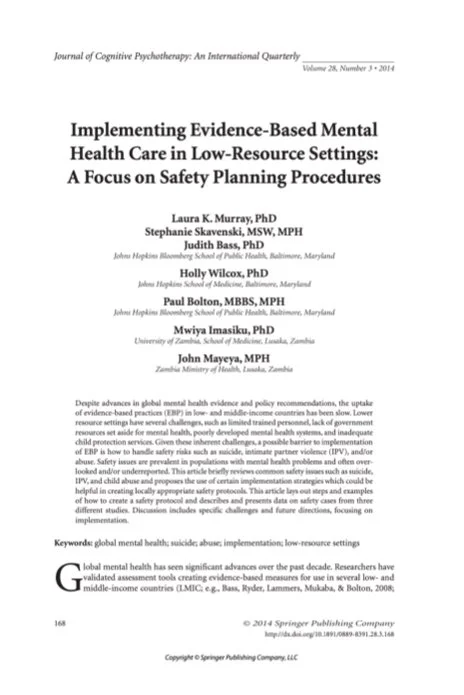
![Title page of a journal article titled 'Implementing Evidence-Based Mental Health Care in Low-Resource Settings: A Focus on Safety Planning Procedures' by multiple authors.]()
Implementing Evidence-Based Mental Health Care in Low-Resource Settings: A Focus on Safety Planning Procedures
-
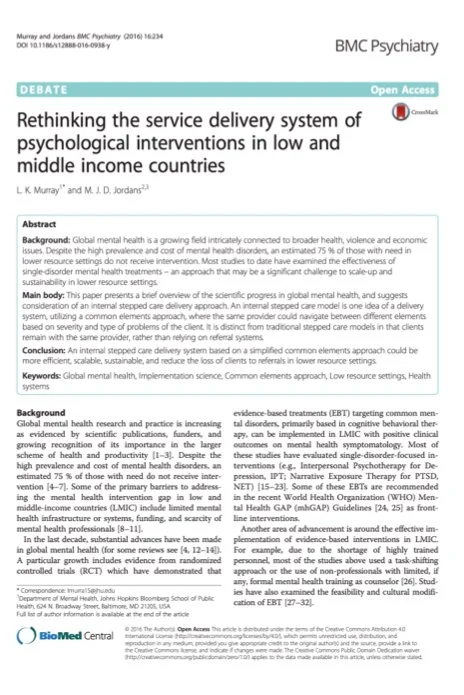
![Title page of a scientific article titled 'Rethinking the service delivery system of psychological interventions in low and middle income countries,' published by BMC Psychiatry, authored by L K Murray and M I D Jordan, with abstract and references visible.]()
Rethinking the service delivery system of psychological interventions in low and middle income countries
-
![Scientific article open on a computer screen with text discussing mental health and evidence-based interventions, titled 'Transdiagnostic treatment approaches for greater public health impact'.]()
Transdiagnostic treatment approaches for greater public health impact: Implementing principles of evidence‐based mental health interventions
-
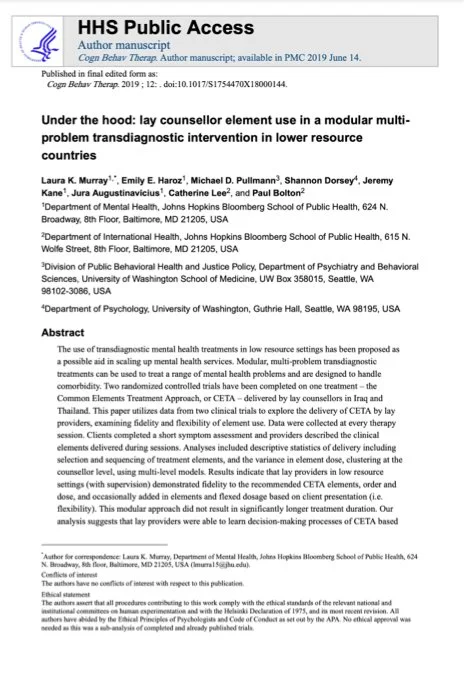
![Title page of a research paper titled 'Under the hood: lay counsellor element use in a modular multi-problem transdiagnostic intervention in lower resource countries', authored by Laura K. Murray and colleagues, published in 2019 in COGH Behavior Therapy.]()
Under the hood: lay counsellor element use in a modular multiproblem transdiagnostic intervention in lower resource countries
-
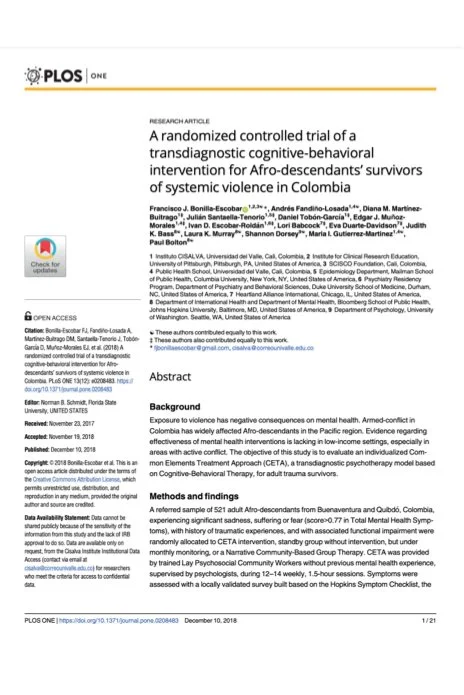
![Title page of a research article from PLOS ONE about a controlled trial of a cognitive-behavioral intervention for Afro-descendants survivors of violence in Colombia.]()
A randomized controlled trial of a transdiagnostic cognitive-behavioral intervention for Afro-descendants’ survivors of systemic violence in Colombia
-
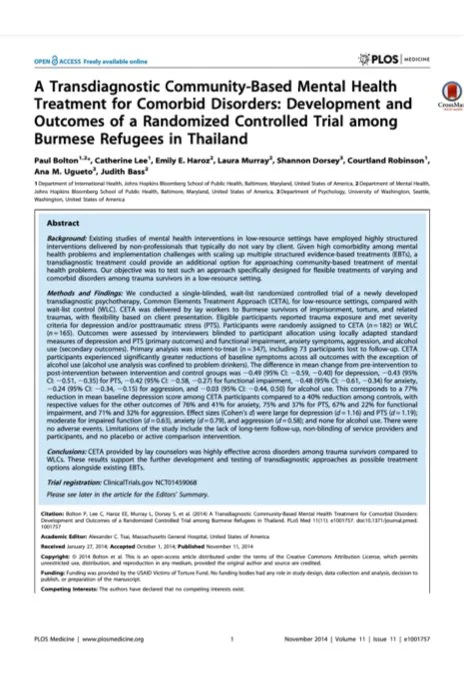
![Title page of a scientific research paper discussing a community-based mental health treatment for Burmese refugees in Thailand, including authors, abstract, and publication details.]()
A Transdiagnostic Community-Based Mental Health Treatment for Comorbid Disorders: Development and Outcomes of a Randomized Controlled Trial among Burmese Refugees in Thailand
-
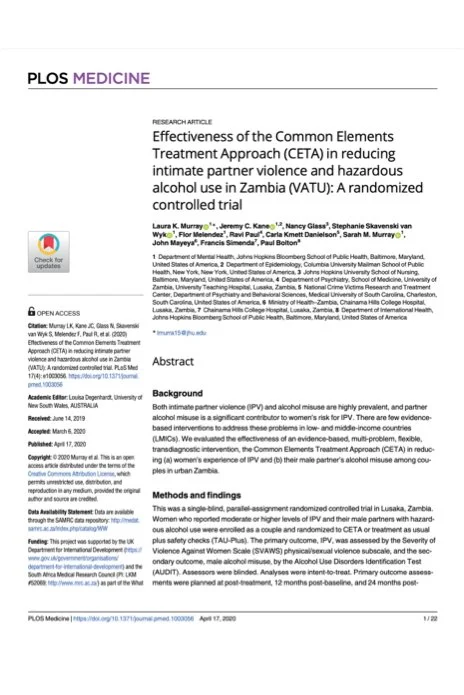
![Research article titled 'Effectiveness of the Common Elements Treatment Approach (CETA) in reducing intimate partner violence and hazardous alcohol use in Zambia.']()
Effectiveness of the Common Elements Treatment Approach (CETA) in reducing intimate partner violence and hazardous alcohol use in Zambia (VATU): A randomized controlled trial