

The Next Era of Mental Health Training Begins Now
Meet our breakthrough simulation platform that trains frontline workers and lay providers to deliver evidence-based psychosocial support — safely, confidently, and at scale.
Your workforce has never had a tool like this.

Imagine . . .
You're a community health worker in rural America.
You’ve just graduated and you are the only mental health support for 5,000 people.
A teenager sits across from you and says:
"I can't get out of bed anymore. I keep thinking about that night . . . I don't think I can go on.”

You know this matters.
You want to help.
But you’ve had no real practice for moments like this.
The Hard Truth:
Therapeutic skills don’t come by having a degree, or a 2 week training.
These skills only develop after HUNDREDS of cases and supervision.
And yet, we ask frontline workers and new graduates to support entire communities . . .
without truly being able to practice conversations they’ll face on Day One.
This is happening everywhere.
Across states, hospitals, schools, refugee agencies, and rural clinics.
We’re not just facing a global shortage of 10 million mental health workers — we’re facing a chronic shortage of effective, evidence-based care.
Systems don’t just need more providers.
They need better-prepared providers.
But there hasn’t been a way to train both at scale.
Until now.




Meet EBT Sim.
AI Flight Simulator for Mental Health
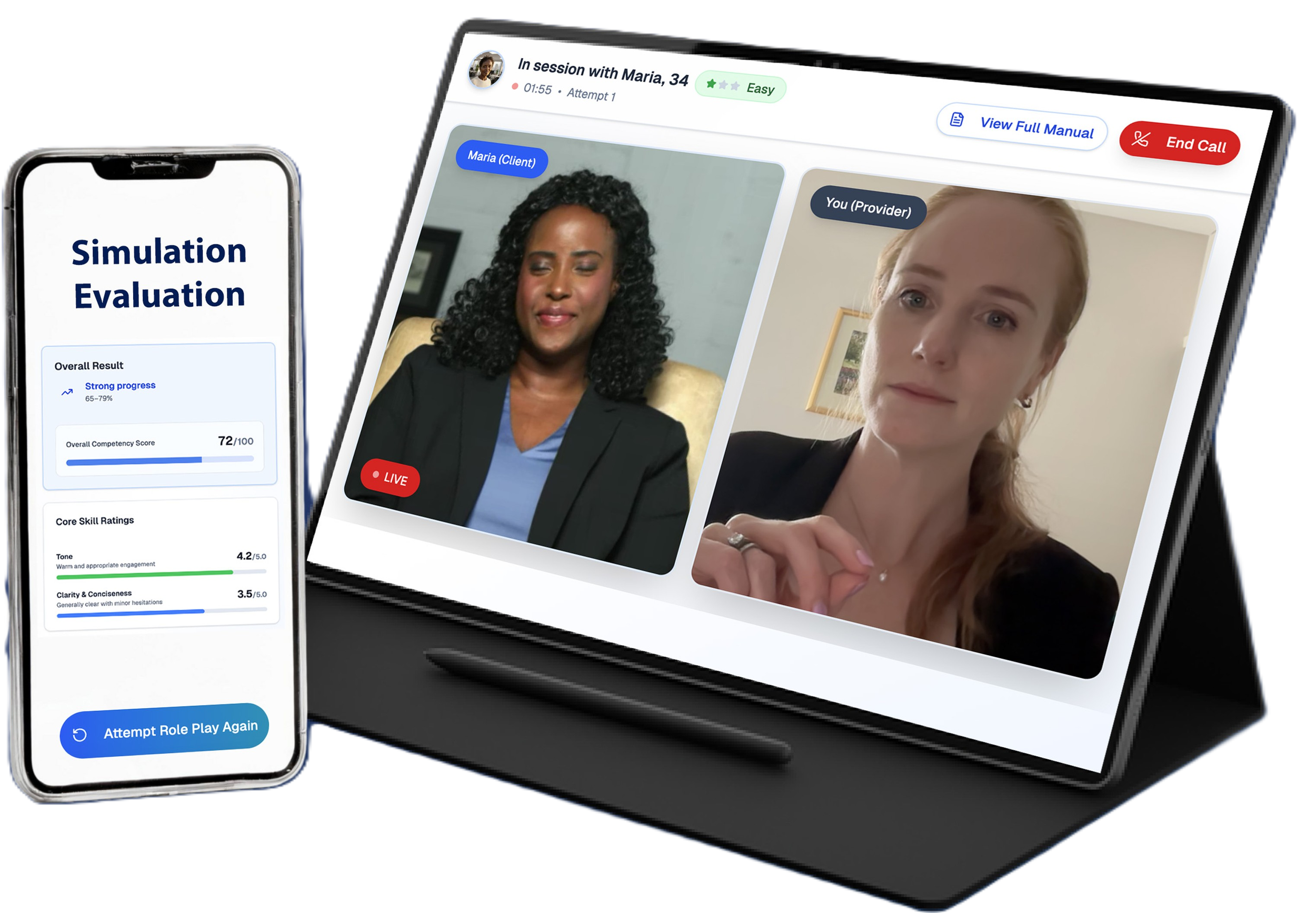
Learners step into immersive, avatar-based role plays where they can safely practice the core skills of CETA Psychosocial Services — anytime, anywhere.
The system listens. It adapts. It challenges.
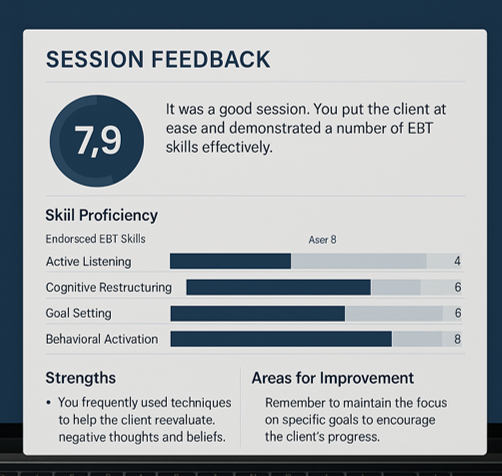
And it teaches and evaluates each step using validated, evidence-based criteria.
The result?
A confident frontline workforce ready to support low-severity cases and extend the reach of licensed clinicians.
The Bottom Line
Why This Matters for Governments & Health Systems

Build Workforce Capacity
Faster Than Ever
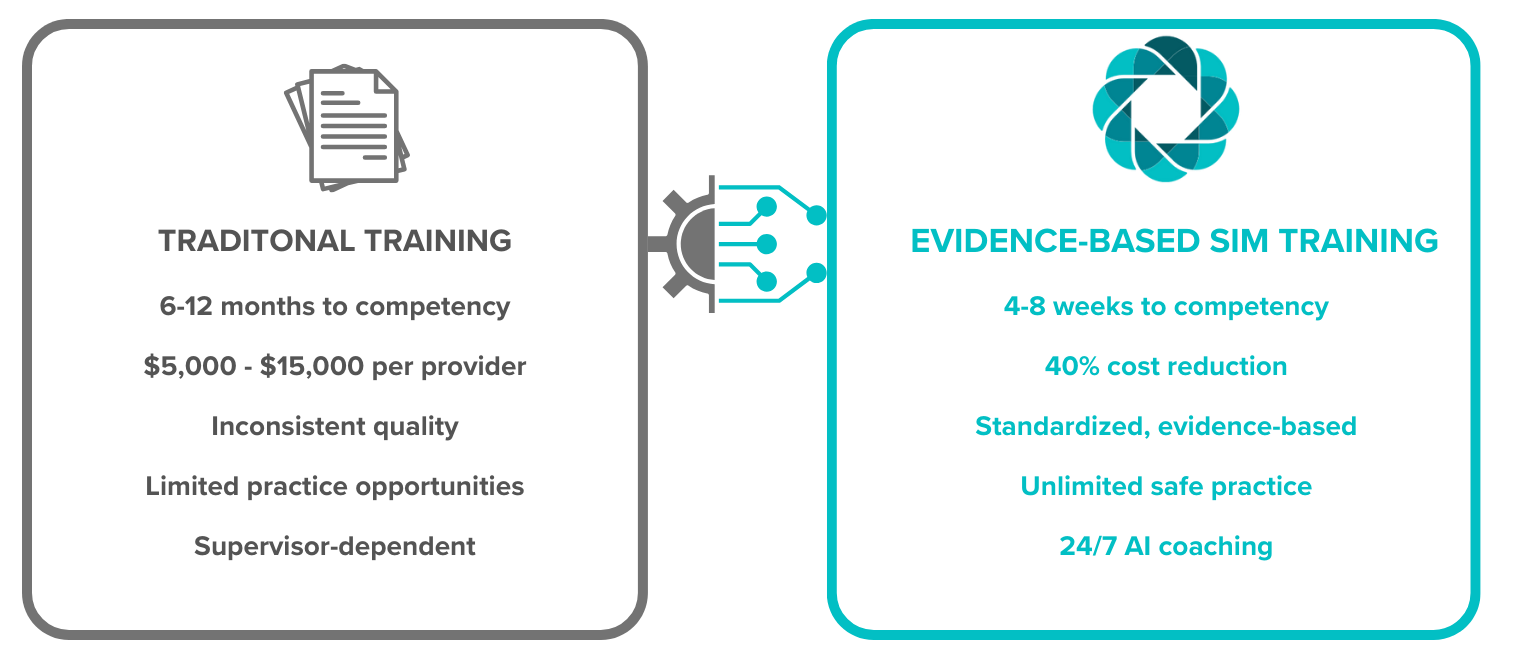
With EBT-Sim, any organization can train hundreds or thousands of frontline workers and lay providers at once — without relying on scarce supervisors or classroom bottlenecks.
This is how you finally scale access.
Deliver Standardized, Evidence-Based Care Across an Entire Region
Every learner practices the same steps. Every learner receives the same coaching. Every learner is evaluated by the same fidelity criteria validated across a decade of CETA research.
This is how you raise the floor, everywhere.

Reduce Training Costs While Improving Performance
EBT-Sim delivers unlimited role plays; instant spoken and written feedback; and targeted action items tied to specific evidence-based steps.
This is the most cost-effective way to build a capable behavioral health workforce.
Built on 20 Years of Clinical Research
EBT-Sim is built on two decades of evidence-based training protocols developed at Johns Hopkins, validated across dozens of countries in Asia, Africa, Europe, and the United States.
What Makes CETA Global Different
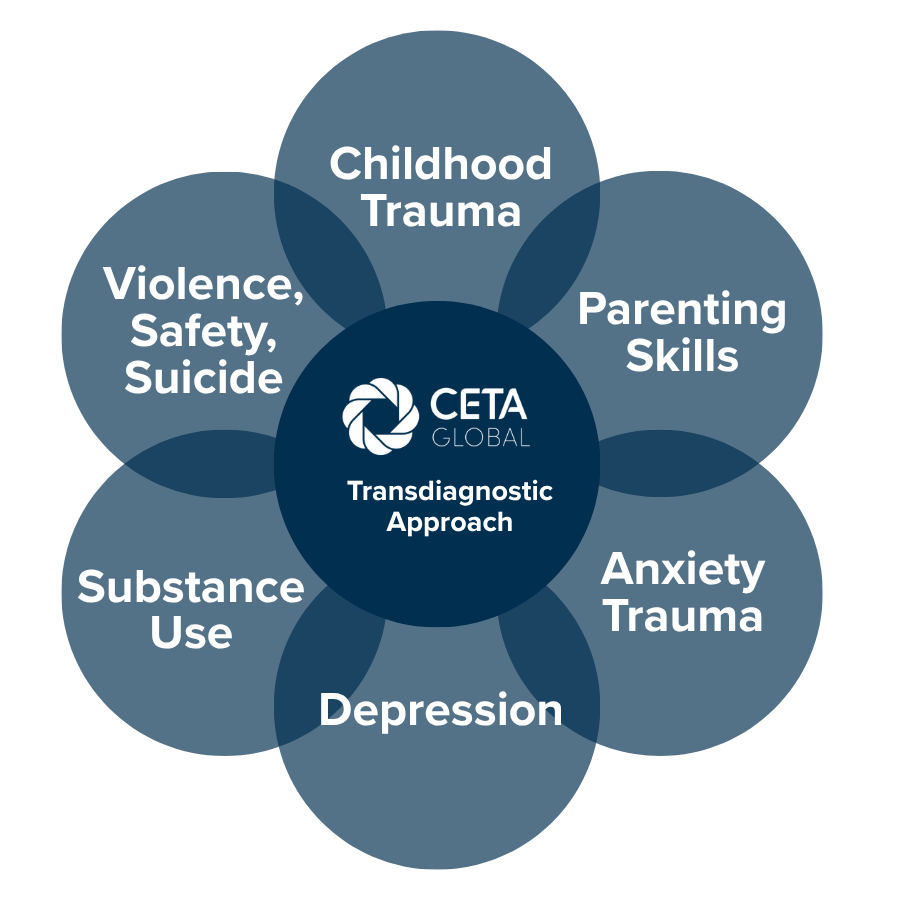
Transdiagnostic, evidence-based approach proven across cultures.
Multiple languages and culturally nuanced scenarios.
Unique multi-agent AI architecture that ensures clinical quality.
Privacy-first design—no real patient data, ever.

This isn’t AI for AI’s sake and this isn't experimental tech looking for a use case. CETA Global has 20+ years of clinical science, now accelerated by AI.
Join Us in Transforming Mental Health Training
We're seeking mission-aligned partners to bring evidence-based training to communities worldwide.
Three Partnership Tracks
Implementation Partners
Healthcare organizations, NGOs, and training institutions ready to deploy EBT-Sim with their providers.
Pilot programs available
Technical support included
Custom scenario development for your context
Technology & Research Partners
Academic institutions and tech organizations advancing AI in mental health.
Collaborative research opportunities
Co-development of new training modules
Access to anonymized training data for validation studies
Funding Partners
Foundations and mission-aligned organizations committed to global mental health equity.
Sponsor training for underserved regions
Support platform development and expansion
Enable free global access through sustainable partnerships
Get Early Access
Help us democratize evidence-based mental health care.
Be part of the cohort that proves AI can amplify — not replace — human expertise.