
RESEARCH & EVIDENCE
Two decades of research.
Real-world results.
Supported by research from Johns Hopkins, McKinsey Institute of Health, and Google.org, CETA combines rigorous clinical research, real-world implementation, and clinically-responsible technology platforms, to bring evidence-based behavioral healthcare to more people.

With Support From



Research and implementation snapshot.
CETA has been researched, adapted and implemented across diverse health systems and communities in the United States and around the world.
Locations include historical and ongoing research, implementation and training. Not all represent active clinical delivery.
UNITED STATES OUTCOMES
Better outcomes in U.S.public behavioral health.
Washington State · 2014–2015
A state-sponsored pilot introduced CETA across nine public behavioral health organizations, training clinicians and supervisors to deliver care for adults with complex mental health needs.
The published evaluation found significant reductions in PTSD and depression symptom scores, alongside improvements in provider confidence.
Published case study
Percentage changes calculated from mean symptom scores reported in the study. Uncontrolled feasibility evaluation; improvements are not comparative treatment effects.

UTAH, UNITED STATES
More than a treatment, a transformation in care.
Weber Human Services, Utah integrated CETA across its clinical workflows, replacing fragmented treatment approaches with a coordinated model of care. In FY2026, its reported improvement and recovery rate exceeded the Utah statewide average by 15 percentage points.
More people
getting better.
Estimated additional people improved or reached recovery compared with the statewide benchmark.
Based on 3,372 clients with OQ use. Estimated discharged subset: 2,226 clients. Counts are estimates derived from Weber's 58% rate and the statewide 43% rate, not individually verified outcome counts. Observational comparison; Weber implemented CETA across its system of care.

BEYOND THE UNITED STATES
Global implementation spotlight.
The CETA system of care has been implemented and studied in diverse settings around the world, adapted for local contexts and populations. Our global work demonstrates the effectiveness and scalability of CETA across cultures, languages and systems.



CHILE CASE STUDY
Expanding the workforce via task sharing.
In Santiago, existing community professionals were trained and supervised to deliver CETA to youth in schools and to adults in other every day settings, increasing access to evidence based care for people experiencing mild symptoms, without the need to acquire a larger pool of licensed clinicians.
7-17x
Estimated social return on investment.
With 1.1 billion people globally facing mental health challenges, Google.org's GenAI Accelerator is proud to support CETA Global. By using secure AI to provide culturally relevant role-play training, EBT-Sim empowers community-level workers to deliver vital care exactly where it is needed.

THE NEXT FRONTIER
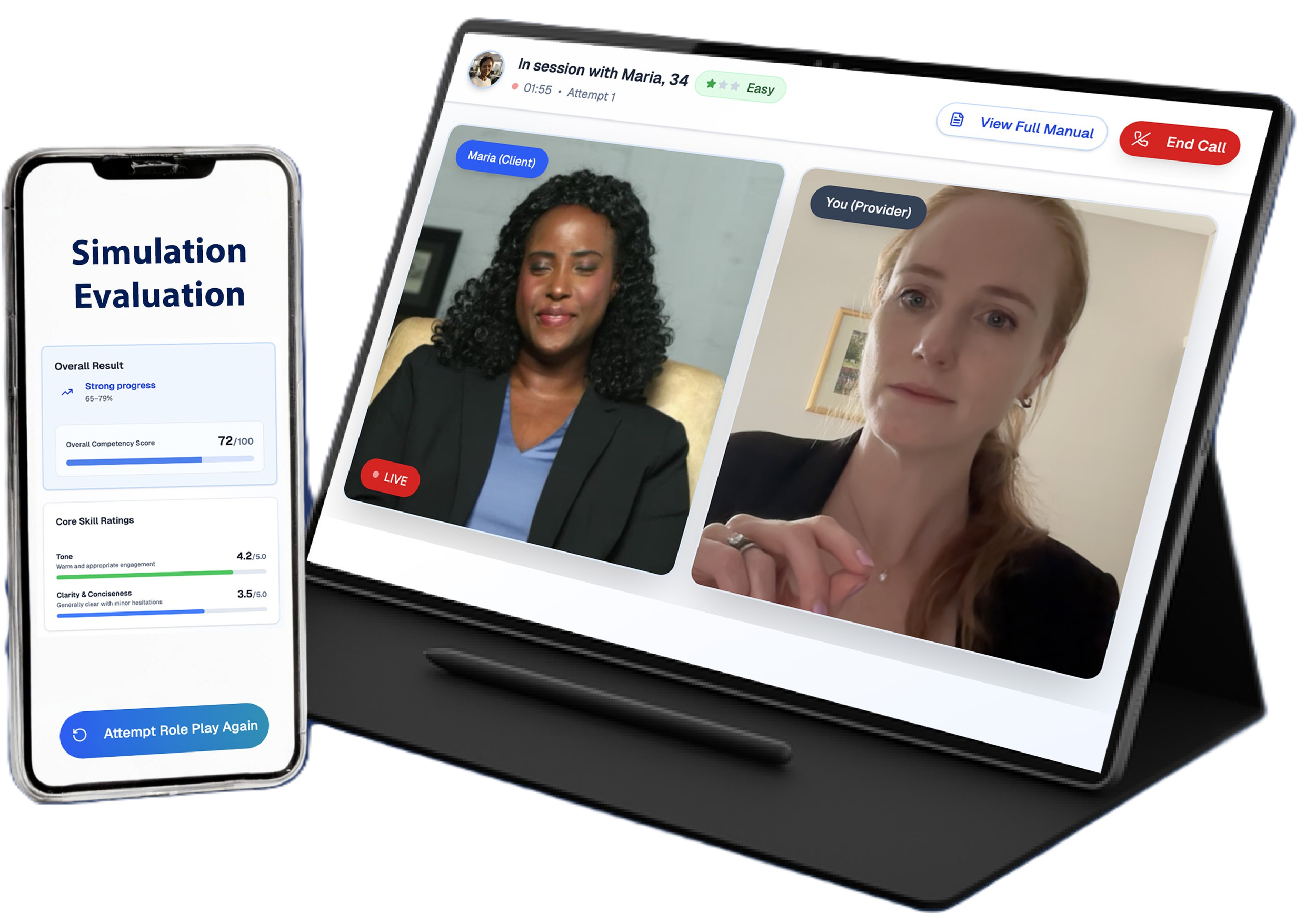
Integrating an AI-powered simulator to accelerate skill development.
With support from Google.org
CETA is exploring how AI-powered simulation can make evidence-based clinical skills practice more accessible, repeatable, and scalable. giving providers opportunities to build confidence and attain mastery through simulated realistic conversations and structured feedback, before meeting real clients.
Explore more global research.
Read the peer-reviewed studies behind CETA's clinical evidence and real-world implementation.
Studies examine specific populations and delivery models. Clinical findings do not automatically establish results for every CETA offering or digital platform.

“CETA gives us a way to provide quality care to clients in an efficient manner that actually works for community mental health. ”-- Vern
Outpatient Counseling Center
CETA | Common Elements Treatment Approach is facilitated by a multi-disciplinary team at Johns Hopkins School of Public Health exploring and addressing behavioral & mental health topics around the world.

© 2026 CETA Global | Johns Hopkins Bloomberg School of Public Health. All Rights Reserved.