
What if we treated mental and behavioral healthcare with the same precision we expect from cancer care?
With CETA that’s possible.
We work with countries, states, payers, and health delivery systems to put a more effective model of care into practice—combining evidence-based treatment, a supported workforce, and technology that guides care delivery and measures progress at scale. The result? More people getting better and more from every dollar.
Developed at Johns Hopkins
Twenty years of e
03
Strategy Design
THE REALITY TODAY
One person.
Many problems.
A fragmented system.
People rarely fit into a single diagnosis. Yet our systems today treat mental health as a series of separate problems, with different providers, waitlists, and disconnected care.
This is costly, inefficient, and burns our providers out.
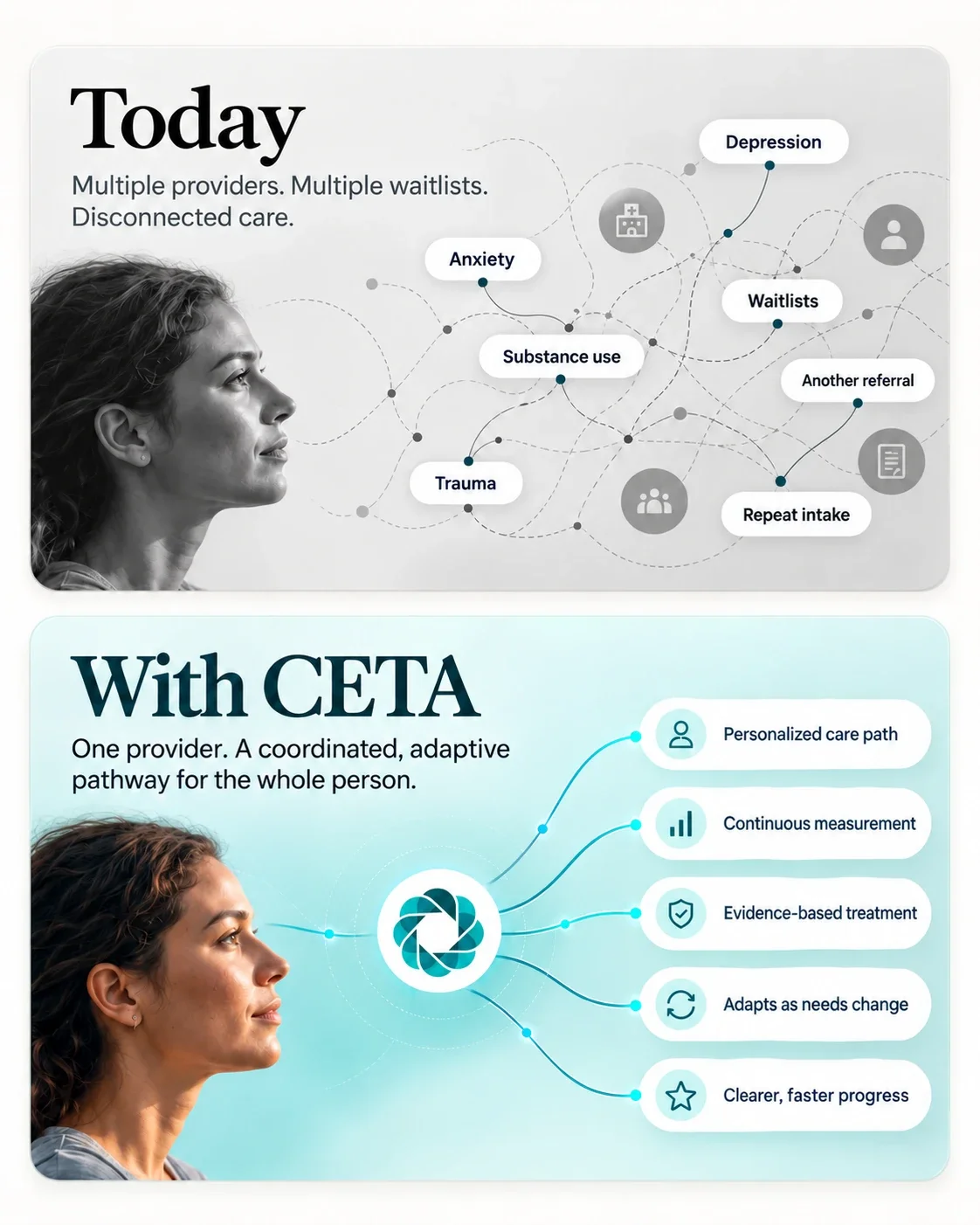
Inspired by cancer care. Built for behavioral health.
What if we could generate a clear, personalized care pathway for each patient—with treatment delivered by one person, guided by evidence, measured along the way, and adapted as needs change.
How much money could we save on care if we streamlined workflows and used technology where it counts? And what would it take to make that standard practice across an entire care system?
That is what CETA puts into practice.
Twenty years of evidence.
Eight clinical trials.
Globally implemented.
What the future of care delivery looks like
01 / 03
With CETA:
More people get better.
CETA's improvement or recovery rate compared with traditional care sites in the same urban area.
n=3,372 clients with OQ use. Discharged subset estimated at 66% of clients (~2,226). Weber's improvement/recovery rate = 58%; Utah urban center rate = 38%. Estimates based on historical discharge rate.
02 / 03
In fewer sessions.
Average CETA sessions to discharge
vs. the 25-50 sessions with traditional care.
Comparison care
CETA
Weber Human Services. n=583. CETA reduces the total number of treatment sessions patients need by addressing multiple co-occurring conditions within a single evidence-based approach, rather than through separate specialists and siloed treatments.
03 / 03
With better economics.
Estimated cost savings.
Compared with the cost of training, supervising, and maintaining multiple separate evidence-based practices (EBPs) within a single site. care setting, and implementation.
It’s that simple.

INTRODUCING
A scientific approach
and a new possibility.


Transforming how care is delivered.
CETA redesigns and streamlines how people move through behavioral healthcare—from their first assessment through treatment and progress toward recovery. We work with your organization to connect care workflows, equip providers to address multiple needs together, and embed the technology that sustains the change.
The result more effective and cost-efficient care at scale.
Redesigned care delivery
Assessment, referrals, treatment, and supervision are redesigned around an integrated approach, reducing fragmentation and duplicated work.
A capable expanded workforce
Paraprofessionals, licensed providers and supervisors are trained, supported, and certified to deliver the CETA model, building lasting capability within the system.
Infrastructure that sustains savings
Digital guidance, clinical care pathways, supervision tools, and outcomes measurement sustain the new model while helping reduce ongoing operating costs.
HOW WE DID IT
We broke down the barriers that hold better care back.
Because fragmented care costs us all.
When behavioral health systems fund separate models for different needs, complexity and cost accumulates across training, supervision, measurement, and implementation.
The CETA approach streamlines and transforms care end-to-end, from intake through discharge.
Fragmented care
Multiple models to train, supervise, and maintain
The CETA alternative
ⓘ About this comparison
This conceptual illustration compares separate treatment-specific operational structures with CETA's shared system of care. Dollar signs represent funding commitments, not proportional costs or estimated savings. CETA addresses multiple clinical needs within its scope; specialized services may still be required.
Frequently Asked Questions
-
We deliver advisory and implementation services in strategy, operations, marketing, and technology.
-
We calculate fees based on scope, complexity, and projected resources, then present a transparent proposal.
-
Engagements range from two weeks for focused audits to several months for comprehensive transformation.
-
Yes, we remain actively involved until solutions are fully operational and staff are confident.
-
Our adaptable methodology serves manufacturing, retail, professional services, and public sector entities.
See the CETA system in motion.
We present dynamic visual case studies that validate our comprehensive solutions.